Somehow it took me until today to piece together what’s going on with the Crystal Temple. Granted, this is a topic the show has studiously avoided returning to since it was introduced way back in episode four. We get some of its effects—its “metaphysical constructs,” as the Gems describe them—but no more mention of the Heart itself. I’d always felt like this was a big, weird loose end; it’s a concept someone had put a bunch of time into early on, then dropped.
Only now, it strikes me. Explicitly, the Heart is portrayed as advanced Gem technology. And Gem technology, morbidly, tends to run on actual living Gems. Obviously the shifting interior, it’s all light constructs, generated by the Crystal Heart—a powerful Gem, that’s been harnessed to do this massive projection task. This would follow the same horrific logic where Gems are integrated into objects and buildings on Homeworld, and how the CGs didn’t think twice about the cracked Gem-powered mirror they found by the Galaxy Warp all those thousands of years ago.
Heck, the job that the Crystal Heart does, it’s basically the same as Lapis’ mirror—both in regard to materializing images of things that had or might exist (albeit three-dimensional ones, compared to Lapis’ flat lens), and in responding to voice command. It’s just that it’s a huge, elaborate installation piece, compared to Lapis’ more modest, portable portal.
That latter bit, about the commands, is especially unnerving as far as what it suggests about a lingering consciousness.
Who did the Temple use to be, I wonder.
The Temple interior… it’s physically safe for the most part—as presumably it’s all, or mostly, light projection in there—but psychologically, it’s always been “off.” Rose’s room in particular, it’s never been a place where you really want to spend more time than you need to.
Requesting things from it, configuring new constructs, it’s like making wishes on a magic lamp. The genie does what it wants to, no matter how carefully you phrase your command, and it’s not going to go well in the end. The Crystal Heart, it’s willful. Full of seeming resentment. It’s not altogether malicious, but it’s not happy, and it seems to lash out passive aggressively every opportunity that it can.
A Gem powerful enough to project a glitch-terror version of all of Beach City at once, it’s… gotta be pretty high up the hierarchy. And if Lapis has had problems adjusting over the course of five seasons, I imagine a Gem that powerful, if set free, would be… trouble.
Lapis is powerful. She’s almost certainly the strongest Gem we’ve seen outside of a Diamond, and she may even rival them if she stops holding back out of fear of herself. Whoever the Crystal Heart used to be, assuming I’m reading this right, must be like a minor god.
Someone who could harness the reality-shifting powers of the Crystal Temple, and focus them outward—I can see how it might take all four Diamonds to control it, and them not even really being enough. This is a person you’d really rather have on your side than not, ideally.
It—I’m not saying it is, but I wonder if… you know… the expanding team, needing its own space… they try to reconfigure the Temple interior, and…
Just shoving a pin in this. It’s… well, it feels like something I would do at this point. Especially given what it would mean, dismantling the Crystal Gems’ sanctuary. If you want to spell the end of an era, that’s not a bad route to go.
Despite its long, complex story and rich themes and character development, Steven Universe can sometimes come off as childish—particularly to those who dwell on plot progression. Often this comes in the same breath as critique of the show’s themes as inappropriate for such a childish piece of media. There’s a cognitive dissonance here to be sure, but it doesn’t come from within the show.
The issue may be that the work it does is largely internal: emotional labor, if you will. The maturity in Steven Universe is comes from personal development: dealing with mental illness, trauma, the complications of relating to others; learning to judge actions, not people. People do awful things sometimes, for reasons based in the pain they carry. Separating the two is one of the first steps toward empathy, justice, and healing.
The show isn’t a grim-dark melodrama; as it unfolds, it becomes a complicated, sober discussion of how experiences affect a person’s emotions; how emotions drive people’s thoughts and behavior; and how this expresses itself internally, externally—individually, interpersonally, systemically. All this can result in generational cycles or systems of violence and abuse—unless it’s addressed at its root.
At the start of the show, the main cast has mostly been frozen in place, unable to grow or move on, for thousands of years. Nearly every character carries some trauma; serves to represent a particular kind of mental illness. The show’s vision of maturity involves learning how to do better. There are no easy answers, relapse is the biggest part of recovery, and mental illness is forever. But, there are ways to learn to respond better—and to break the cycle.
The show’s major conflict lies in the attitudes and circumstances that reinforce these patterns: in the oppression of the status quo. For all its chirpiness, Steven Universe is underlaid with an existential horror, derived from invalidation: the fear of one’s fundamental wrongness, as dictated by others. This comes home in the final arc of season five, which through its strengthened language and focus on themes like conversion therapy nudges the show’s window just enough to lay bare the trans allegory that has in hindsight been woven into the show from day one.
Progression in the show largely deals with breaking down assumptions: about one’s self, about others, about the world that we live in. A big part of that involves learning about and de-mythologizing the past: trying to really understand how things came to be the utter shit that they are today, so you can start to find a way to avoid repeating the same mistakes over and over—and just maybe, build a better future.
Plot—this idea that there’s a driving, correct order of events that we’re supposed to take in our lives—is one of those major assumptions. Steven Universe is never really about Things that Happen; in the show as in reality, little that happens happens without cause or consequence, because of fate or some higher demand. The plot is there—structured meticulously to provide a constant pull on the action without calling much attention to itself—but it does its best to keep out of the way. Instead the story comes from the moment-to-moment interactions between characters and how they explore the show’s underlying themes—themes that get messier and messier as the show goes on.
Even the plot-bomb episodes, like “A Single Pale Rose,” what makes them interesting tends to be less the Things that Happen than, well, the mess: all the surrounding implications, and how they feed into what we know of everyone’s psychology; how it clarifies their behaviors, and might show them a route forward.
This kind of development, it’s difficult to showcase in a reel of Mature Goings-On. Reduced to action and individual moments, it’ll just look like a bunch of crying and longing glances and people looking apprehensive. It’s a novelistic form of storytelling, that rewards and relies on engagement. Meet it halfway, and the show unfurls, revealing a difficult kind of a conversation that most television actively chooses to avoid.
The maturity comes in working through all the crap put on a person by society, by prior generations, by relationships—all the expectations and judgments and every reason why one should be ashamed of who one is—and finding the start of an inner peace.
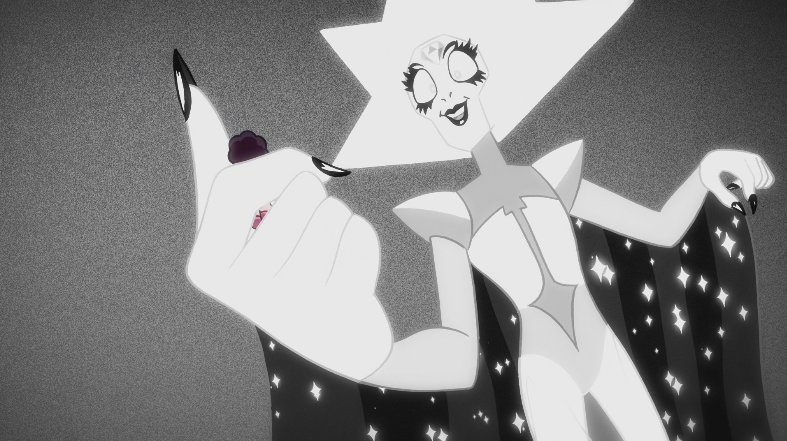
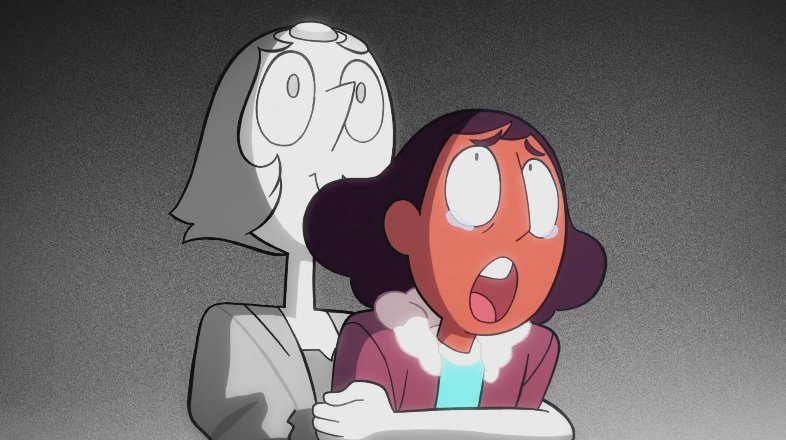
I think I touched on this before, but in kinda the way that our first encounter with Uncle Andy presages Steven’s later attempt to change the mind of a bigoted relative on the other side of the family, “Kevin Party” sets up just how shocking White’s behavior is in that encounter.
It’s a subtle thing, maybe; the show paints Kevin as the most irredeemable character in Beach City. Even the worst of the Homeworld Gems, their destructive behavior comes out of their training and biases and assumptions, which can be challenged and changed. Kevin is just a sociopath—but even Kevin, with his weird raging hard-on for himself, wouldn’t stoop as low as knowingly misgendering someone. Like, seriously, who would do that?
You can excuse most Homeworld Gems, who don’t have a sense of gender. But, White? She knows. And she makes a point of it.
That whole encounter with White, that’s the first (and thus far only) time the show depicts behavior like this. Outside of again just not parsing the concept of gender, it was simply off the table for even the grossest, angriest, or most otherwise bigoted characters. As usual, the broadcast schedule makes things weird; just on an episodic basis, it isn’t all that long between the two encounters, first showing what in real-world terms feels like startling magnanimity from Kevin, then shortly later cashing in the contrast. Kevin’s attitude, it helps to establish the stakes and the nature of the threat at the show’s climax.
The show saves it for the climax, because this is the big, existential fear at the heart of the show; the thing it spends five seasons avoiding, dancing around, not wanting to vocalize—yet that drives all of its thoughts and actions, much as Pearl’s or Amethyst’s or, yes, Pink Diamond’s inner traumas define the characters that we come to know.
Backtracking a little: we do get a bit of a preview of White’s behavior a couple of episodes earlier with one of the lesser Diamonds. Though even here you can see the terror in her face. Like all the other Gems, she’s playing the role she’s been handed as well as she can.
Before this episode, the show had never quite underlined the trans subtext to fusion. I mean, yes, it emerges with Stevonnie as a non-binary figure—but it turns out their human terms are exemplary of the general case, not an exception. Every fusion is a Stevonnie of sorts. It’s just that Gem society doesn’t have sex or gender; it has type, which fills those roles, plus race and class.
A ruby and a sapphire fusing into a new being, who calls herself a garnet—there are assigned-at-emergence garnets on Homeworld. It’s, you could maybe piece some of this together before “Together Alone,” but here the show just comes out and says it: in the terms of the show’s mythology and metaphor, Garnet is basically trans.Yes, we’d seen some lower-ranked Gems respond to her with confusion, disdain, or worse—but this episode, as the centerpiece of the Homeworld arc, really serves to nail down the trans overtone of that arc, which in turn serves to consciously shift the narrative window of the entire show.
This business with the more abstracted misgendering toward Garnet, it then serves as a direct setup to the thitherto unprecedented transgressions of White, toward Steven, another 40 or so minutes on.
I’ve said before how much I enjoy the nightmare structure of this episode, which actually starts on a literal nightmare and then progresses exactly as you know it has to based on the title and premise. Unavoidably, like watching a car crash in slow motion, being helpless to stop. A while ago I mused on the show’s relationship with horror, and that’s what this whole episode is. But, it’s a Lynchian form of horror that the show hadn’t really gone into very deeply before. “Together Alone” is like Eraserhead with a PG rating.
It’s easy to dismiss “Together Alone” as a slow nine minutes, then a final two minutes of discomfort at a character acting in the only way they ever would, which their entire character arc led toward, but which armchair writers love to call dumb and out-of-character, then shock. But, again, it… you know. Let’s ignore the people who don’t know story structure and don’t know how to engage with television. And let’s even ignore the episode’s role as a fragment of a larger serial narrative. Just taken on its own, “Together Alone” is pretty remarkable.
As it wears in, it’s coming to fit as one of the strongest, strangest episodes of the show; one of a special circle that has the most to say. It’s very possibly one of the best episodes since its namesake, “Alone Together,” some 120 chapters earlier—though it’s a bit of a sleeper to get to that point. Like Blade Runner, it takes a lot of post-processing to work out the significance of what you’ve seen.
It chips at the subconscious. It’s all just so very distressing, on levels far beyond the linear story events, which are quite dramatic on their own—though in a show like this you’ve a sense of the stakes and structure and what must, or is at least extremely likely to, happen as a result, and what won’t. So it’s not clear why you feel so upset, and the knee-jerk impulse is to blame something: the plot, the characters. You lash out, because the story is working as it’s meant to. You’re uncomfortable.
And that’s kinda what Steven Universe is. The actual plot beats are the least of it, here as always. For 160 episodes, plot is incidental to what the show has to say or takes the slightest interest in exploring. It’s there, and it’s meticulously structured, but it’s obligatory. For an episode like “Together Alone,” focusing on plot is like obsessing over the big picture to Lost Highway. I mean, you can do that. But, you’re kinda… you’re not engaging with the story on the level that it’s working, you know?
The events that happen at the end of the episode have to happen by the sheer existence of the episode. You anticipate them, if not beat-by-beat then something close, from the moment you see that the episode exists. And that’s built into the structure, into the horrible anticipation throughout. So for most of those eleven minutes of a lifetime, it draws out every ounce of that discomfort and twists it, makes it a little bit weirder, a little more alien, puts you into an even less certain place than you thought you were, while you watch the horror play out to script.
At a point you think, seriously, what is this shit? This is all so unnecessary.
Which is exactly the point.
It’s not just us. Ruby, Sapphire, Amethyst, Pearl, they all see what’s happening. They all stand, helpless, and watch, knowing what’s coming—hoping it doesn’t, but unable to change things. We’re all part of the party, all in concert with our foreknowledge of the awful inevitable—while the show’s two effective leads wander off into the distance, the same way you-as-audience watch you-as-character in your own worst nightmares, knowing as their orchestrator exactly what’s coming, screaming at yourself to stop—but you can’t hear you, and you just keep going.
There’s another thing here. Because the moment of horror, the thing that must not happen, it’s the purest thing. It’s the embodiment of love, joy, self-discovery. Stevonnie’s always used to explore this duality: the euphoria, paired with the often-existential anxiety. “Together Alone” takes that to another level, and translates it into the show’s most raw concept of threat.
This is the trouble of metamorphosis. There’s the liberation in finding and accepting yourself, and exploring what that means, and all is fine in theory—but then, you run into the way the world responds to you. And the terror sets in. Whether that’s a million peering eyes and Kevin, or an entire bigoted society. To this point, Stevonnie’s anxieties have been internal, psychological. They’ve been developmental hurdles for them to transcend. Here, the show’s whole world crashes in. The vague danger posed by their identity, always overcome by the positives to the point we’ve nearly forgotten the threat, it becomes manifest.
Music that long ago, in a more innocent time, represented everything pure in the world, now plays for menace, much like the chopped-up, mangled version of “Stronger Than You” that plays when Garnet meets the forced fusion experiments, or Rose’s corrupted theme during Greg’s info dump about the war, and what the Gems had been doing on Earth all that time.
And we’re not even at White, yet. And the basic problem of Steven himself.
Anyway. Steven Universe is just such a marvel of storytelling. Most things, you know, the more you pick at them, the more they fall apart. It takes a certain level of literature for the opposite to be true, where the more scrutiny you give it, the stronger it gives back.
I just adore this show to bits. If you’ve been putting off watching it, seriously, just do. Especially if you’re a liberal arts lit nerd, or whatever, and you know how to read a text on the level it intends. It’s the very best thing, and just so different from other stories.
If you haven’t seen it, this is the best possible time to do so. The show as originally conceived has wrapped; that story is done, and can be taken as a whole. There’s a movie coming, and what looks like a sequel show, maybe-kinda, which will begin a new story. For now, though, you’ve got a whole summer to catch up. And then watch it all another four times, in your disbelief.
(Of course, the network makes it as hard as possible to watch complete, uncut, in order. Streaming is a mess; the DVD situation is worse than useless. If you want to watch it, it’s better to follow less-licit routes, where things tend to be better curated, in higher quality.
How long this‘ll stay up, who can say, but everything here is of a high bitrate, and organized in correct story order.)
So the shit is, with the emotional defenses I’ve leaned on most of my life, the only people who tend to get through the barriers I’ve set up are those:
With superficial charm
With no sense of boundaries
Who refuse to take “no” for an answer
Kind of a big failure there. One of my big projects this year, I think I’m going to have to map out a re-wire of my whole social alarm system.
End effect of my current setup, the people who’ve gotten close enough to have a controlling influence on my life have tended to be aspirational boomers. Like, they see everything as an acquisition and the world as a game to be won. Life is theirs to claim on a whim, and whatever may stand in the way of a want is the cruelest form of oppression.
I’m not really into acquiring things (aside from irregularly adding to media libraries, but I don’t see ideas as things so much), or winning… much of anything. And I don’t understand most burning desires. So I guess this makes me a perfect foil, until they start to feel foiled.
Since I’m not a person in their eyes as much as a erroneous order in this service industry we call life, this leads to a constant state of “I want to speak to the manager,” and this cycle of abuse while I scramble and fail to do what apparently is expected of me in situations like this. They tend to assume everyone thinks like them, so I could only be messing up so badly on purpose to fuck with them, as part of my own twisted agenda. And, how dare I.
Anybody with an ounce of sense or sensitivity tends to, you know, leave me alone. But maybe, the sensible and sensitive are the people I’d less mind if they didn’t. Because most of my idea of relating to others, it’s been shaped by people in that first category, which is what’s made me so paranoid about others.
Not everybody is that awful. Heck, most people aren’t. It’s only the people who I can’t chase away so easily.
There’s also the detail about trusting myself and not giving in where it feels wrong, not compromising my own values to whoever has the stronger personality. Which has always been a problem. But, you know. If you’re gonna build safety filters, might as well make sure to calibrate them right.
As ever, don’t take this as me dictating the One Right Experience—I’m just talking about me here—but for me the one big story that for decades shielded me from recognizing my gender issues (blinding as they may be) is our collective obsession with sexuality. We sexualize the concept of gender. We sexualize—or at least romanticize—all relationships, all emotions that connect us to others. It becomes this minefield of expectation; of these models of behavior, of feeling, of thinking, of existing, that you’re expected to fall into—and if you don’t, there’s something wrong with you.
Tied into all this are problems with representation, where unless you look for it, anything outside the gender binary might as well not exist except as a fetish. I know this is also a problem for other marginalized identities—objectification as the only recognition. You’re only valid to the extent you serve a purpose. I am terrified of being objectified; I have been for as long as I can remember. As long as I’ve been aware of sex, I’ve felt this vulnerability that I only recently have come to understand.
I don’t experience sexual or romantic attraction, but for most of my life I’ve been led to confuse empathy with a guilty sort of desire; for all that I’ve been told my affinity must be sexual, I recognize something isn’t quite right with that story. That uncertainty, that intangible sense of wrongness, it festers, leading me to feel just awful about the whole thing. There’s this anxiety that builds up about ever identifying with anyone, despite this strong relational draw to, in particular, gender non-conforming women (and active repulsion from identifying with men).
Getting through that, to nail down and embrace my sexuality, that was the first step—and it took me ages. Once I had drawn that division, I was free to unpick all the severed threads, to see where they led; what was going on with my attitudes. It’s only then I was able to recognize what I had so clearly been feeling the last four decades and why; how strongly I responded to seeing myself reflected in others, despite failing to grasp what I saw or how it affected me.
The notion that it was possible to be a gender non-conforming woman regardless of one’s assignment at birth, and not in the context of some fetish for someone else’s benefit, but just as a person, as an identity—it’s not a story one tends to encounter too often, culturally.
To exist for one’s own sake and not for the sake of someone else—this is such a long road. For that, I blame our culture’s obsession with sex and sexuality, none of which applies to me or the way I look at the world or myself. You know, I’m just me. I’m not here for any purpose except to be who I am. And through all this noise, I couldn’t see me at all.
As I say, other people are wired in their own particular ways, and take comfort and interest in things that bore me or make me want to cry. They’re not wrong for being who they are. It’s just that this one narrative, about how we’re meant to think and feel and relate to each other—it’s not The One. It’s not correct. It’s just a million slight variations of a single narrow story. Other stories are available.
The concept of sex, it was a shackle to me. To others it’s the key. The story is only wrong when it’s forced on you. And that’s the real point here.
Your story, it comes from inside. In this month of bricks and riots, and at any other time of the year, don’t let anyone else tell you who you are. Don’t buy into this notion that your script is sitting there, waiting for you to act out. Everyone around you, they’re all working through their own garbage, looking for validation of their own. But their stories, they have nothing to do with you. Yours is for you to tell yourself.
Love starts with you. Be kind to yourself, listen to what you’re saying—and let that make the whole world a better place to be.
There’s so much speculation about the next era of Steven Universe, and what it will involve. “Change Your Mind” wrapped up so many of the surface conflicts, it’s hard to see a way forward—which is because there is no way forward. The show’s gonna tell a different story from here, as they’ve said. And like the first time around, it’s not going to be a story about villains and monsters and intergalactic conflict. The plot, the melodrama, all the objective things that happen—none of that matters, really. They could be anything. What matters—in all things, but particular in the case of this show—is what all those details serve to discuss.
There’s some stuff that—really, the crux of this question lies in some things on the show that haven’t come out yet, that really bring the arc of my relationship with Steven full-circle? […] Steven and I have had a very similar arc in life, and very similar trials in life of having a much larger allocation of responsibility than normal placed on our shoulders at a young age—and, rising to the challenge of that, and what kind of mental things come from that. It’s been pretty eye-opening. Just, like, recently, like in the past few weeks, some of the revelations I’ve had, about that.
The comments that Callison has made lately, they fit my expectations and hopes for the next stage of the story. Which is to say, the show’s original coming-of-age story has reached its end point—so what’s the next natural story to tell after that? The difficult transition to adulthood. Things only ever get more complicated and harder to manage, as you grow up. In most things you do, there are no right choices; just less awful ones—and personal growth, it kind of tends to flatline while one spends all one’s time on things that have nothing to do with one’s own concerns. It becomes unsustainable after a while, but since you’re an adult now people just expect you to get on with it.
On the basis of Callison’s statements as to how his life and Steven’s have become one and the same, and the things that are going on in the recording right now are surprising him with how precisely they parallel his own life situation, it sounds like this is indeed where we’re going. Which is kinda where the show has to go, if it’s gonna be honest. Callison has talked about the amount of responsibility Steven had to carry from a young age, and the… effects that can have on a person. And we know Callison’s been dealing with some health issues lately.
So basically, I expect a scenario where Steven has been accepted as not just the de facto leader of the Crystal Gems, or the reincarnation of Pink Diamond, but the architect of a new era for Gems and humans alike—and everyone expects him to know what to do all the time. Assuming some time has passed, Steven’s relationship with Connie would likely also have developed, which would have its comforts but also its own, different kind of responsibility.
Potentially, it’s been around five years, allowing sort of a reboot from a series perspective, letting new viewers jump into this scenario and figure it out just as established ones are doing so (like the Time War business in Doctor Who). (Added benefit: this should allow Callison to relax and use his natural voice in the role.) Everything has become strange and alienating; everything Steven has known is changing in front of him, and no one’s really watching out for him anymore. And then, something snaps. And he can’t take it. And the story comes from there.
This also gives the story a circularity, if you consider Pink’s actions. So much of Steven Universe is about trying to break the cycles, avoid repeating past mistakes and abuses, trying to do better than the last generation was able. But also, so much of the show is about failure and relapse and getting things wrong.
How often do people say with some horror, when they start to grow up, “Oh my God, I’m behaving exactly like my mom”? There may be a little more horror to that realization in some scenarios than in others.
The deal with the last year or so is, after the crash made it clear that the interfaces I’d been running just weren’t tenable anymore, it’s been this intense period of messy, laborious deprogramming before I can even get around to installing a new operating system up in here. Nearly every part of me, the instructions I’d been given over the course of four decades were completely wrong, and the labyrinth of workarounds I’d built to manage them—they never quite worked, but in the course of recent system overloads they had melted into irretrievable slag.
Just based on these alpha builds I’ve been putting together, this new code, that for once reflects my system architecture—gosh, it’s… lighter. Is this what it means to be a person, I wonder, and not a tool for someone else’s life? I just, it’s so much easier to be me, for me. Compared to the fucking disaster simulation I was running until so recently.
Yes, okay, we can try to reverse-engineer the expected output of an allistic cishet male; we’ll just build an emulator on this autistic aroace nb demifemale hardware we got sitting around. Why this hardware? It’s all we got! And that’s the only operating system compatible with the formats we’re gonna be handling. So, make do! See if we can simulate those cues with a < 50% fail rate.
Works just awful! Overheats and stutters constantly! But, it’s… fine, if you give it time and space. Well not really fine, but it can maybe sort out the result eventually, if you’re patient. Wait, how many instructions are you going to feed in here?
Oh.
Uh… okay, well. That might take a few custom scripts, to deal with the extra demand. They’re extra glitchy, and can’t run too many at once or else it—no, it’s… look, you can’t just push its buttons like that. You need to enter one character at a time, see? What do you mean, throw it away? It’s—there isn’t anything else. This is all there is. There will never be anything else. You just need to know how to—wait, where are you going? It…
Maybe I can reboot it?
Hello?
Seriously, my whole life has been like trying to emulate a SNES on Sega Genesis hardware.
Okay, so, gender update for those keeping careful notes. This whole process, it’s a matter of letting go of enough to allow me to identify a more-or-less static point. My gender is in no way fluid; it’s been the same as far back as I can remember. It was just obscure to me. What makes it tricky to identify is that it’s not a binary identity. I just don’t get the gender binary. Both extremes weird me out, and strike me as performative nonsense. But, I’m clearly not male! Never have been. I feel no affinity with even tepid maleness. Quite opposite.
With some distance now, disentangling some of my wiring from the expectations of all these years, I’m more clearly able to see what’s happening. I’ve been coming at this from the wrong perspective. I’ve been taking it as a retreat from maleness, but… I was never male to start? It’s more accurate to flip the board. The question isn’t about maleness, because that’s not a question. The question is about femaleness—because I don’t feel, never have felt, entirely female in a strict binary sense, but, importantly, I do feel a basic connection to this sphere. Just, not all the way.
There’s a specific point where I sit, where my mind has always been. It’s something like 40% female, 60% nothing-in-particular. And, I’ve always felt the most in common with those in that general range: gender non-conforming women. This is the kind of non-binary we’re looking at. Roughly. Sort of. I guess we could say, demigirl/demigal/demiwoman: kinda female, kinda not. However we frame it, the specific question is here is of femininity versus neutrality.
This has always been how I’ve thought of myself. I just, it’s been difficult, and scary, to get to the point of seeing and identifying and acknowledging and accepting and, now, embracing. I’m genderqueer, yes—but from the other angle than I had been trying to approach it.
Right now in terms of expression and identity I feel like I’m kind of lapsing back from the center, more deeply into a basic underlying femininity that doesn’t fully define me, and I wouldn’t want it to, but is… there, clearly, nonetheless. Which is the basic dynamic I feel. This is getting close to a final word, as far as figuring out what’s going on with me.
I’m, when I’m in a place that I can afford it, I intend to go on HRT. This should help to put a few more tiles in place—neurologically more than anything, frankly. Catch me up more fully.
What I find kinda interesting is how all of this goes along with sexuality. I’m clearly aroace. I just—I don’t work that way. And with the above in mind I now better understand some of the confusion I’ve felt. What I’ve often confused for romantic or sexual attraction, it’s more empathy; identification. I haven’t known how to process what I’ve felt, and so I’ve done it poorly, through a bad model that someone else handed to me. It’s curious to go back; see how this maps over the years. How really what I was feeling in most cases was, “I see myself in you.” (But, not like… that.)
There are still many dynamics to unpack, and this will probably take the rest of my life. But. I’m at least on a course to allow this to happen. And, it’s happening.
I guess that’s a thing about the way I approach concepts: I have intuition, right. And my intuition is often well-founded and correct, at least in regard to things I’m prepared to make conclusions about, but I’m not prepared to accept it until I establish the detailed reasoning. Often in the process of reasoning it out I realize I’m off on the wrong track, or I’m mistaking what I see due to that whole tunnel-vision thing—missing relevant details, that would suggest a different reading. So there’s this paranoid rigor I need to commit before I’m satisfied.
If something doesn’t fit, and I don’t have a reason why it shouldn’t, it really fucking bothers me even if the overall picture seems consistent and right. It takes forever for me to procedurally web through and tie off all these tiny threads. And I’ll probably go back; revise!
Anyway. This whole shift of perspective here, that lines everything up correctly—it establishes many other parallels I hadn’t considered. I’ve never bought into masculinity on any level at all; what I’ve worn all my life is this noncommittal neutral mask, much as one masks for autism. And it’s never been a lie, exactly; much as one’s autism mask is a projection of the least objectionable and most functional parts of one’s self for allistic circles, so as to avoid being singled out as a problem, this gender mask never served to pretend something was there; just to deflect.
Fact of the matter is, the best I could do was cling to the truth of this neutral space: no, I don’t subscribe to the gender binary, but here’s this… confusing void for you to misinterpret, because that’s the best I can do. This is as male as I can give you: this… whatever-it-is. Which was never ever convincing! My whole life, everyone around me has known there’s something up. Without a guide to interpret this limbo, usually they conclude I’m gay. And get very concerned about that. Which has complicated, and is complicated by, my asexuality to no end.
I’m terrible at masking. It’s exhausting, and I just don’t know what I’m doing. I’m also very bad at lying except by omission, which just leaves these conspicuous voids. And there’s the whole demoralizing element, knowing that who you are is so objectionable that you can never ever let go. Never let the mask slip for one second—which only makes it the harder to keep up. You just internalize everything. And every time you do slip, which will be constantly, others will be quick to jump in and let you know. You just learn to dissociate. You’re awful and wrong and not worth thinking about, even on a basic level; even to take care of your daily needs. All you’ve got are these thin, cracked masks that aren’t fooling anyone, and this swirling, anxious void behind them where all you can do is find things to lose yourself in because the alternative is facing this loathsome monster that everyone keeps identifying for you.
Again, though, that gender mask, it’s based in a weird kind of truth, or allergy to lies at least; my gender, it’s not binary. I don’t get the gender extremes. They’re so strange and performative to me. I think, what are you people even doing, and why? I’m, like, 60% agendered. So, that’s what I’ve held up, limply, to hide the rest of the answer that’s so much harder to grapple with.
But, as I’ve been saying since I’ve started to be open with myself, when I have to pick one or the other on a form, the obvious answer is female. I’m not a woman, exactly, entirely, but the other option doesn’t apply at all! Not a little. And, I’m not absent of gender entirely. There’s something there. I’m just, I’ve never had an opportunity to get in touch with it. I don’t know what to do with it yet.
Right now, genderqueer is the best general descriptor. It captures that essential ambiguity, all with a tone of icon-smashing defiance. But now that I’ve established the what and where and how of that ambiguity. to more precisely define myself as a demiwoman (demigirl? demifemme?) resolves all those conflicts.
So all that mild sense of disquiet, of knowing that I wasn’t quite getting something right, and nervousness about what that might be? That’s pretty much evaporated. I’ve assembled a pretty good sense of myself, at least as far as this dimension is concerned. Now I can move forward, and figure out what it means to me—and what, if anything, I may be able to do about it.
The King of Fighters has always carved out a queer-friendly space. It has an enormous cast, defined more than anything by personality dynamics—representing a huge array of gender expressions and unconventional relationships. The team dynamics in this series are akin to found families. With a few exceptions, no one in KoF is ever fighting alone. Personal support systems are the norm.
Of the fourteen main games in the series, The King of Fighters 2001 is easily the queerest—with ’99 as closest runner-up. (That whole K’/Krizalid storyline sure is something!) Those bookends to the NESTS saga (the second story arc in the series, with KoF 2000 in the center) are the most I-don’t-give-a-fuck, expressive chapters in the series, unconcerned with expectations, with fitting into forms. Instead they spend their time grasping and scraping the margins to say what they feel they have to say, even if it comes off as broken or ugly or annoying.
The preceding Orochi saga had been, to a large extent, about living up to roles and expectations foretold centuries before one was even born. There are queer dynamics within that, but what’s astounding about the NESTS arc is how it dumps the rest and redoubles its attention on those elements.
There is something so essentially queer about the NESTS saga, coming up as it does to shred everything that came before, oust the main character, and refocus the series on this new sci-fi story about finding identity that’s been systemically stolen.
The team dynamics, which define KoF as a sereies, becomes all the stronger in this period, with larger teams allowing a more complete and varied support system and more potentials for character interaction. Part of the story progress is watching the likes of K’ slowly assemble his crew—which takes almost-full form with 2001.
All of the principle cast, during the NESTS years—it’s about discovering who they really are apart from how everyone else views them and all the burdens they carry. Even Kyo and Iori getting dumped from the burden of series leads for a while to focus on each other fits this.
2001 is the least fuckful of the trilogy, both in its astounding-it-even-got-made design and its story and aesthetics. It is what it is. The characters are embracing who they are, the good and the bad. The art isn’t trying for gloss: it’s as straight-up expressive as it’s been. I am on record for feeling the most affinity with this game, out of all of them. I think I’m developing a better handle on why.
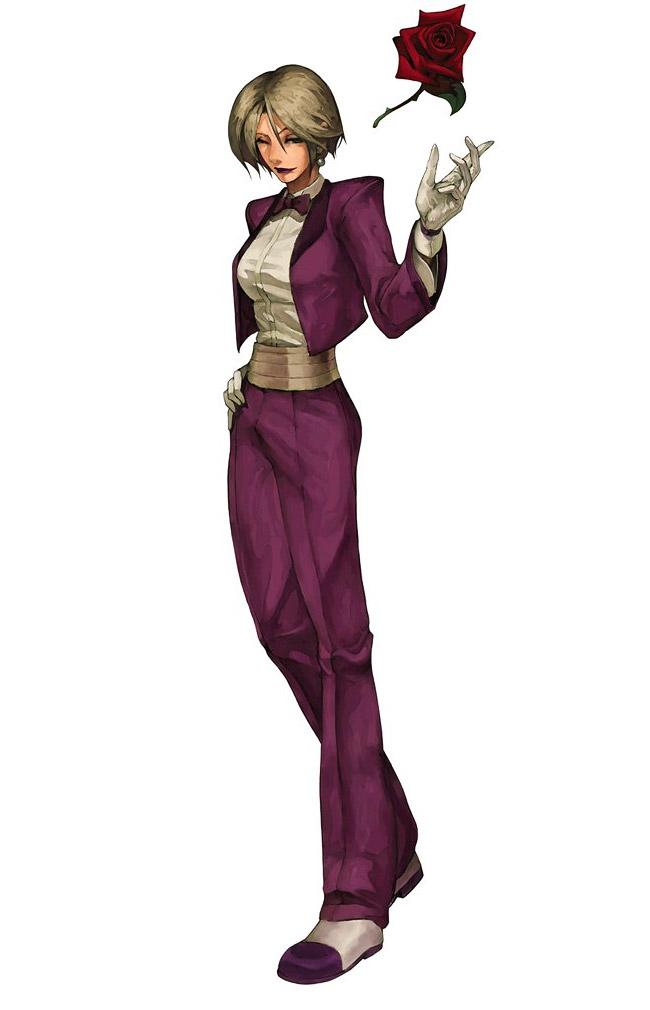
King, the most stable presence in the franchise—so named for her gender ambiguity in her first role.
Also, on the EDM/queerness axis, the NESTS era has the best music in the series. Which is saying something, considering the series is known for its music almost as much as Castlevania or Mega Man or Sonic. Into which I stubbornly rope the 2001 AST, yes:
Though given their polish, ’99 and 2000 are a bit of an easier argument:
I mean. If you’re gonna have a queer-coded sci-fi revamp, might as well go full EDM, right?
And Christ, if we’re talking about associated emotional issues, the level of angst the series rises to in this arc:
I’ve mentioned this in passing, but I think it’s worth establishing that Steven seems to have stopped developing normally when he moved in with the Gems—all-but immortal beings who never themselves change without outside influence and have little understanding of humanity.
We can see this in the extended introduction:
At the start, he’s visibly younger: smaller, higher voice. His clothes are ill-fitting. There are gaps from his baby teeth. It’s implied he’s only begun to learn the uke, though he’s picked it up quickly.
(Mind you, it’s on record that he stopped aging at about eight, which in typical human terms, for what that may matter, lines up with the adult teeth growing in.)
The house is still being built, but it’s pretty far along. Fast forward through a building montage; next we see Steven, which it’s reasonable to count in months rather than multiple years, he’s moving into the newly-completed house. Here, he looks the same as he does in the show.
After he leaves the care of Greg, the Gems don’t engage with Steven. They hide everything. Garnet waits for his back to turn, to retrieve and bubble gemstones. Until he forces their hand (mostly after meeting Connie!), they continue to treat him as he was when he moved in.
And so due to his strange hybrid physiology, where like a Gem his physical form corresponds to his self-concept, Steven never progresses past the mentality of an eight-year-old—ergo, for something like four years (again, until meeting Connie!) he never grows up.
Without her, Steven may never have started questioning the miraculous life around him that never quite adds up, never pushed back against the Gems and started to claim his own agency… and the Earth would very probably have been destroyed about a year and a half from “Gem Glow.”
People clown on season 1a, mostly with better-than-usual reason, but even the very earliest episodes are something, more often than not.
From “Frybo,” S01E05
Sometimes it seems to me that people who regularly watch television really, really hate writing. Especially without a clearly signaled end goal.
From “Lars and the Cool Kids,” S01E14
The thing is, even if the show were nothing but Steven wandering around town and talking to people, it would still be an extraordinarily well-written series. That all of this just serves as context and connecting tissue for bigger topics and events should be a point of amazement.
From “Steven’s Lion,” S01E10
That it’s written to this standard without a script is, I think, worth mulling over a bit. It’s just storyboards. People tell the story as they draw.
I’m not super jazzed about Jamie, and this whole episode is pretty strange, it being the first one they animated and… uh, not really matching the tone or stylization of anything to follow—but it’s these little conversations, showing the characters’ inner- and off-screen lives…
From “Cheeseburger Backpack,” S01E03
The way the show goes out of its way to avoid linear, A-B, obligatory transactions—if people are gonna talk, it’s going to be organic, tell us something about who they are, take some weird turns that aren’t strictly necessary because not everyone is on the story’s schedule. Even the walk-on characters—Jamie doesn’t turn up again for something like 50 episodes—are the main characters of their own lives, and aren’t necessarily invested in the priorities of whatever nonsense is going on with the people we’re following at the moment. As they wouldn’t.
Most of the drollery is in observing everyone’s strange habits and hang-ups and limitations, and how they define their bubbles and perspectives and way of thinking and way of responding to everything. There’s an unusual level of psychology to this show.
From “Joking Victim,” S01E21
It’s interesting to view this sequence in the context of that conversation with Peedie, a few episodes earlier.
There’s a whole hell of a lot of Charlie Brown in Steven Universe. As the show openly acknowledges a few times.
From “So Many Birthdays,” S01E13
I’ve mentioned this before, but I love the cautious way Sadie steps between Lars and this strange, potentially unhinged man who walked in. These are the little beats that make the show what it is.
There’s this level of melancholy behind everything the show does, no matter how gentle or light-hearted or weird. This yawning existential pit, that the show just barely manages to dance around.
From “Onion Trade,” S01E15
Just barely.
From “Steven and the Stevens,” S01E22
Which fits with this discussion of the show’s relationship with horror. And, yeah; the horror sets in pretty early with this show.
From “Rose’s Room,” S01E19
I suppose repressed anxiety is one of the main driving factors here.
I keep talking about how messed-up every character is in this show. And that’s one of the things that the show both regards with love and refuses to treat delicately. Though it gets more nuanced as it goes along (even by the back half of season 1).
From “Tiger Millionaire,” S01E10
And it’s interesting the unspoken context the show sets out for everything—that it just lets you soak in until it reaches a saturation point, and is ready to squeeze. Like, from exactly one episode after the previous clip:
From “Steven’s Lion” again
That’s what the show does. It drops things in, and lets you digest them as passing gags or non sequiturs, and you laugh them off, but they keep building up—and then when you go back, sometimes something clicks. And you think, oh. You know, there’s something going on here, huh. Season 1a, all the time it’s dinking around with food and toys and idiosyncratic street vendors, it sets up much of the festering that becomes unavoidable later. Even when it (very eventually) gets around to exposition, the show lets you add up most of the implications yourself.
From “On the Run,” S01E40—midway through season 1b
Again, season one is frickin’ long. The back half is in practical terms the show’s sophomore season, and a sequel to or redo of season 1a, more clearly developing the notions it just sort of plants the first time around (ergo that previous clip, compared to the earlier ones)—all of which just makes the earlier episodes seem all the more messed-up, by the things they choose not to address quite yet.
Like, this stuff above—it explains what’s going on, but in the moment is never really addressed, with Amethyst’s general not-so passive aggression, and in this entire episode. Which at the time is just handled on the level that Steven approaches it. He doesn’t ask the questions. Not the right ones, anyway.
From “Giant Woman,” S01E12
This show does so many things at once; at any given time eight of them are in deep background, one is just starting to breach subtext, and usually the least important possible one is being actively explored in dialogue and action, leaving you to wonder what the hell the point is. Until it reaches up through the layers and grabs you.
And even then you don’t quite know why, because you still don’t have the full picture. It registers, it means something. It all fits. But things are the way they are for reasons that take a long time to even start to explain.
From “Coach Steven,” S01E20
Or, as early season 1b would have it,
From “Keep Beach City Weird,” S01E31—five episodes into season 1b
Jesus Christ, this show just dances circles around everything else ever made for television. Even just this early material, if it were produced as live-action, with the exact same dialogue and design and shot framing, it would be heralded as a revolution in TV writing, several degrees above Arrested Development (with which it shares some structural similarities). Animation, though, it kind of makes something turn off in people’s brains. Which, to be fair, is part of why Steven Universe gets away with a fraction of what it does.
After an analysis I read a while ago, that lifted out some things I didn’t see on my own, I can’t watch “Steven the Sword Fighter” again except as the allegory it’s intended, the uncertainty of living under an unreliable parent, suffering from depression or other mental illness.
From “Steven the Sword Fighter,” S01E16
And, God. I mean. I’ve been… on all sides of this. It’s hard to see, but at the same time cathartic and necessary.
If it weren’t for Lapis, Pearl would easily be the most relatable character in the show for me.
From “Mirror Gem,” S01E25
In retrospect one of the things I appreciate the most about the mid-season finale is the way it opens up, partially, about the long game the show has been playing from the start (and will continue to, on levels only hinted at this point). Owning up here lets it keep on piling on.
From “Ocean Gem,” S01E26
The overt romantic elements between Connie and Steven sort of go on the back-burner after season one, as so much else starts to happen that they both have to prioritize before they figure all that mess out. But, early on the show is so raw about what an earnest mess it is.
From “An Indirect Kiss,” S01E24
I like the level here of, love is not minding how gross someone is, and not being afraid to be gross with them. Which is… kind of one of the show’s core messages, if not phrased always in those specific words.
The fact that it’s durian juice, of all incomprehensible things, that’s the catalytic element here, kind of… it goes with the theme, right?
There’s a level of judgment in my choice of vocabulary that the show wouldn’t go near, but it gets the point across.
Well, usually wouldn’t.
From “Lion 3: Straight to Video,” S01E35—in the first half of season 1b
Where the show depicts bias or disgust, it’s framed as an arbitrary personal evaluation, based in factors that are close to incomprehensible from an outside view. It’s always a silly way to look at things, that demonstrates the foibles of a character.
From “Gem Glow,” S01E01
(I’m regularly astounded at how often the background artists redo the exact same scenes from scratch with a slightly different angle or level of detail. I haven’t checked, but wouldn’t be surprised if they actually didn’t reuse much background art at all, even of “standing sets.”)
Anyway. I’m very fond of the brand of humor that goes, “Ho, ho, what you say makes no sense at all—but being human, I am familiar with the mode in which it makes no sense! Yes, those foibles are relatable from my own experience of being flawed and arbitrary.” To wit:
From “Sulfur,” Look Around You S01E04 (2002)
This observational silliness—what are you even doing, and why—is the sort of humor the show revels in.
From “Arcade Mania,” S01E11
There’s a philosophy here, in which we’re all these little imperfect bubbles biased by our experiences in what we’re able to see and understand in the present, and none of what we think and do actually makes much sense, so why not just accept this from ourselves and each other? It’s a view the show expresses in its humor just as it does through the drama and action and horror and tragedy and long story arcs built on carefully seeded mythology. And it’s there from the very first episode, and in every episode since.
From “Change Your Mind,” S05 E29-32
I guess a better spin on the take from a few paragraphs up is, love is seeing beauty—not despite but because of all of the strangeness and complications and imperfections. The things that might put a person off, you’re not blind to them. But they’re facets of something far bigger.
Or, I guess,
From “Laser Light Cannon,” S01E02
As messed-up as everyone is in this show, and as the whole situation may be, that love is such a constant that it makes everything possible. It haunts me, this alternate vision of what a childhood could have been like. Of what in principle any close relationship could be like.


 Unlock with Patreon